
Surah Mulk and Surah Yaseen: How the Two Surahs Connect
Both are Makki surahs about Allah's sovereignty, the signs in creation and the resurrection. Ya-Sin ends with "He in whose hand is the realm of all things" (36:83), and Al-Mulk begins with "He in whose hand is dominion" (67:1).
Last reviewed:
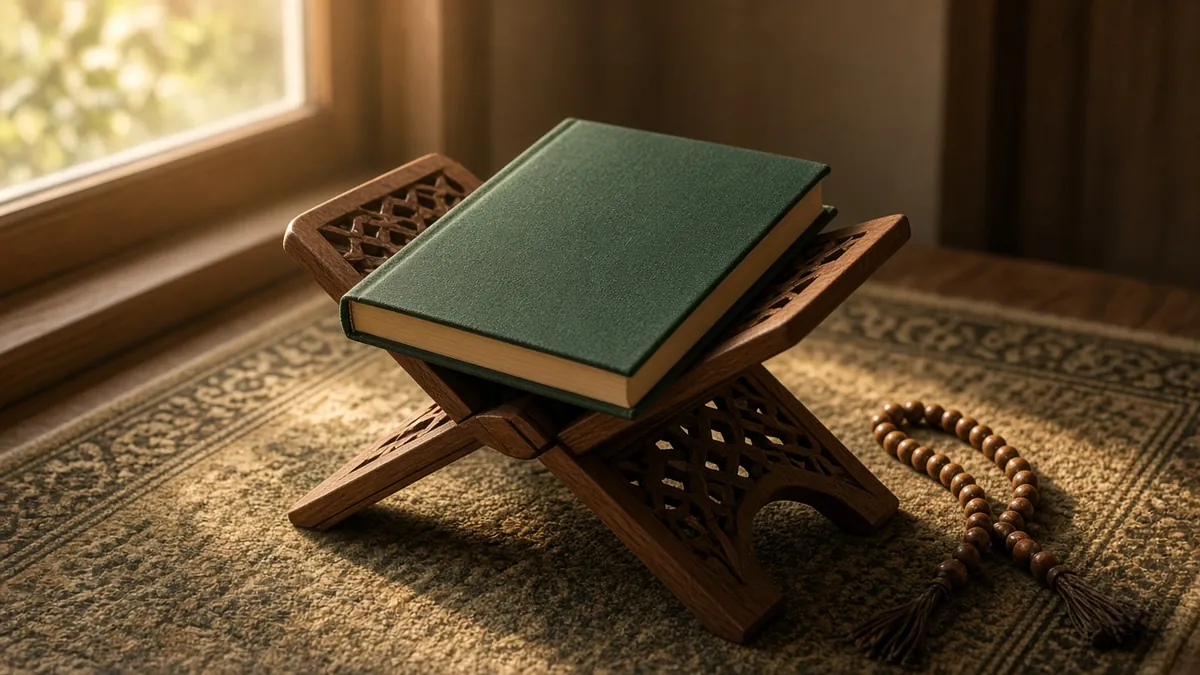
Surah Al-Mulk (chapter 67) and Surah Ya-Sin (chapter 36), often spelled Yaseen, are two of the most widely recited surahs of the Qur'an. Many Muslims know both by heart and read them often. Yet they are seldom studied side by side. This guide compares the two surahs using only the text of the Qur'an: their length and place in the mushaf, their openings, the themes they share, the verses that echo one another, and practical tips for reading them together.
All English quotations are from the Sahih International translation as published on Quran.com, with verse numbers so you can check each one yourself.
Surah Mulk and Surah Yaseen at a glance
| Surah Al-Mulk | Surah Ya-Sin | |
|---|---|---|
| Chapter number | 67 | 36 |
| Number of verses | 30 | 83 |
| Revelation place (Quran.com) | Makkah | Makkah |
| Juz | 29 | 22 and 23 |
| Pages (Madani mushaf, Quran.com) | 562–564 | 440–445 |
| Opening | "Blessed is He in whose hand is dominion" | Ya, Seen. "By the wise Qur'an" |
Both surahs are Makki, so they share the hallmarks of the Makkan period: a focus on the oneness of Allah, the signs of creation, accountability and the resurrection. Surah Ya-Sin is a little under three times as long as Surah Al-Mulk. Our page on how long Surah Mulk is gives more detail on reading time and page count, and which para Surah Mulk is in explains where it sits in the 29th juz.
How each surah opens
Surah Al-Mulk opens with praise of Allah's sovereignty:
"Blessed is He in whose hand is dominion, and He is over all things competent." (67:1)
Surah Ya-Sin opens with two disconnected letters, followed by an oath on the Qur'an itself:
"Ya, Seen. By the wise Qur'an," (36:1–2)
Ya-Sin is one of the 29 surahs that begin with such letters (al-huruf al-muqatta'at). Their meaning is known to Allah. Al-Mulk does not begin with disconnected letters, but with the word "Tabarak," which gives the surah one of its other names. Our page on the meaning of Tabarak explores that opening.
"In whose hand": the verse that links both surahs
The clearest connection between the two surahs is a phrase that opens one and closes the other. Al-Mulk begins:
"Blessed is He in whose hand is dominion..." (67:1)
And Ya-Sin ends:
"So exalted is He in whose hand is the realm of all things, and to Him you will be returned." (36:83)
In Arabic, Al-Mulk speaks of al-mulk (dominion, sovereignty) and Ya-Sin's last verse speaks of malakut (the realm, the inner kingship of all things). Both words come from the same root, m-l-k. Read together, Ya-Sin closes on Allah's kingship over all things and our return to Him, and Al-Mulk opens on that same kingship. It is a beautiful thread for anyone who recites both.
Shared theme 1: the signs in creation
Both surahs ask the reader to look at the world and reflect.
Surah Al-Mulk points to the sky and invites a second look:
"[And] who created seven heavens in layers. You do not see in the creation of the Most Merciful any inconsistency. So return [your] vision [to the sky]; do you see any breaks?" (67:3)
It also points to the birds:
"Do they not see the birds above them with wings outspread and [sometimes] folded in? None holds them [aloft] except the Most Merciful. Indeed He is, of all things, Seeing." (67:19)
Surah Ya-Sin turns to the sun, the moon and the night:
"And the sun runs [on course] toward its stopping point. That is the determination of the Exalted in Might, the Knowing." (36:38)
"It is not allowable [i.e., possible] for the sun to reach the moon, nor does the night overtake the day, but each, in an orbit, is swimming." (36:40)
And to pairs throughout creation:
"Exalted is He who created all pairs - from what the earth grows and from themselves and from that which they do not know." (36:36)
Both surahs use the same method: point to something visible, then ask who sustains it. Our scientific reflections on Surah Mulk looks at these signs more closely.
Shared theme 2: the earth and provision
Al-Mulk describes the earth as made "tame" for people:
"It is He who made the earth tame for you - so walk among its slopes and eat of His provision - and to Him is the resurrection." (67:15)
Ya-Sin presents the revived earth as a sign:
"And a sign for them is the dead earth. We have brought it to life and brought forth from it grain, and from it they eat." (36:33)
Notice how both verses move from food to resurrection. Al-Mulk ends the verse with "to Him is the resurrection," and Ya-Sin uses the dead earth brought to life as an image the surah returns to when it speaks of raising the dead.
Shared theme 3: death, life and the test
Al-Mulk states the purpose of life and death plainly:
"[He] who created death and life to test you [as to] which of you is best in deed - and He is the Exalted in Might, the Forgiving -" (67:2)
Ya-Sin speaks of the record of deeds:
"Indeed, it is We who bring the dead to life and record what they have put forth and what they left behind, and all things We have enumerated in a clear register." (36:12)
Both remind the reader that actions matter and are known. Al-Mulk frames life as a test of deeds; Ya-Sin assures that every deed and its effects are recorded.
Shared theme 4: the resurrection answered
Ya-Sin closes with one of the Qur'an's most direct answers to doubt about the resurrection:
"And he presents for Us an example and forgets his [own] creation. He says, 'Who will give life to bones while they are disintegrated?'" (36:78)
"Say, 'He will give them life who produced them the first time; and He is, of all creation, Knowing.'" (36:79)
"His command is only when He intends a thing that He says to it, 'Be,' and it is." (36:82)
Al-Mulk addresses the same certainty through questions about what people depend on every day. Its final verse asks:
"Say, 'Have you considered: if your water was to become sunken [into the earth], then who could bring you flowing water?'" (67:30)
Ya-Sin's argument is the first creation; Al-Mulk's is daily dependence. Both lead to the same conclusion: the One who creates and sustains is fully able to bring back.
Differences worth noticing
- Length and pace. Ya-Sin's 83 verses include a long narrative about a town and its messengers (36:13–32). Al-Mulk has no extended story; it moves quickly from sign to sign.
- Structure of the ending. Ya-Sin ends with a sequence of arguments about resurrection and a closing praise. Al-Mulk ends with a series of short "Say" questions.
- Voice. Al-Mulk frequently uses rhetorical questions ("do you see any breaks?"). Ya-Sin mixes narrative, description of the Hereafter and argument.
Reading Surah Mulk and Surah Yaseen together
If you recite both regularly, these tips can deepen your reading:
- Read Ya-Sin's final verse, then Al-Mulk's first. Feel how "in whose hand" closes one and opens the other.
- Pause at the signs. When Al-Mulk mentions the birds or Ya-Sin mentions the orbit of the sun and moon, stop and reflect on the sign itself.
- Use a translation alongside the Arabic. Our Surah Mulk in English and word-by-word pages help with Al-Mulk.
- Listen to a reciter. Hearing the rhythm helps memory. See our Surah Mulk audio page.
- Keep a reflection journal. Write one verse from each surah that stood out to you. Our Surah Mulk journal offers prompts.
A one-week study plan for both surahs
| Day | Surah Al-Mulk | Surah Ya-Sin |
|---|---|---|
| 1 | Verses 1–5 | Verses 1–12 |
| 2 | Verses 6–11 | Verses 13–32 |
| 3 | Verses 12–15 | Verses 33–44 |
| 4 | Verses 16–19 | Verses 45–54 |
| 5 | Verses 20–24 | Verses 55–68 |
| 6 | Verses 25–30 | Verses 69–83 |
| 7 | Read both in full | Note the shared themes |
If you are memorizing Al-Mulk, pair this with our memorization tracker or the memorization wizard.
Next: how Surah Mulk and Surah Kahf share the phrase 'best in deed'.
See also how Surah Mulk flows straight into Surah Qalam.
A note on sources
This page quotes only the Qur'an itself, in the Sahih International translation on Quran.com. It does not quote hadith or make claims about rewards for reading a particular surah. For questions of practice, consult a qualified scholar you trust.
Sources: Quranic text verified against Uthmani script (Hafs an Asim). Hadith cross-referenced with Sunnah.com and Quran.com. See our editorial policy.