
Surah Mulk and Surah Kawthar: Gift and Dominion
Surah Al-Mulk (67) has 30 verses and opens Juz 29. Surah Al-Kawthar (108) has three verses in Juz 30. This page compares the wording of both in Sahih International as published on Quran.com.
Last reviewed:
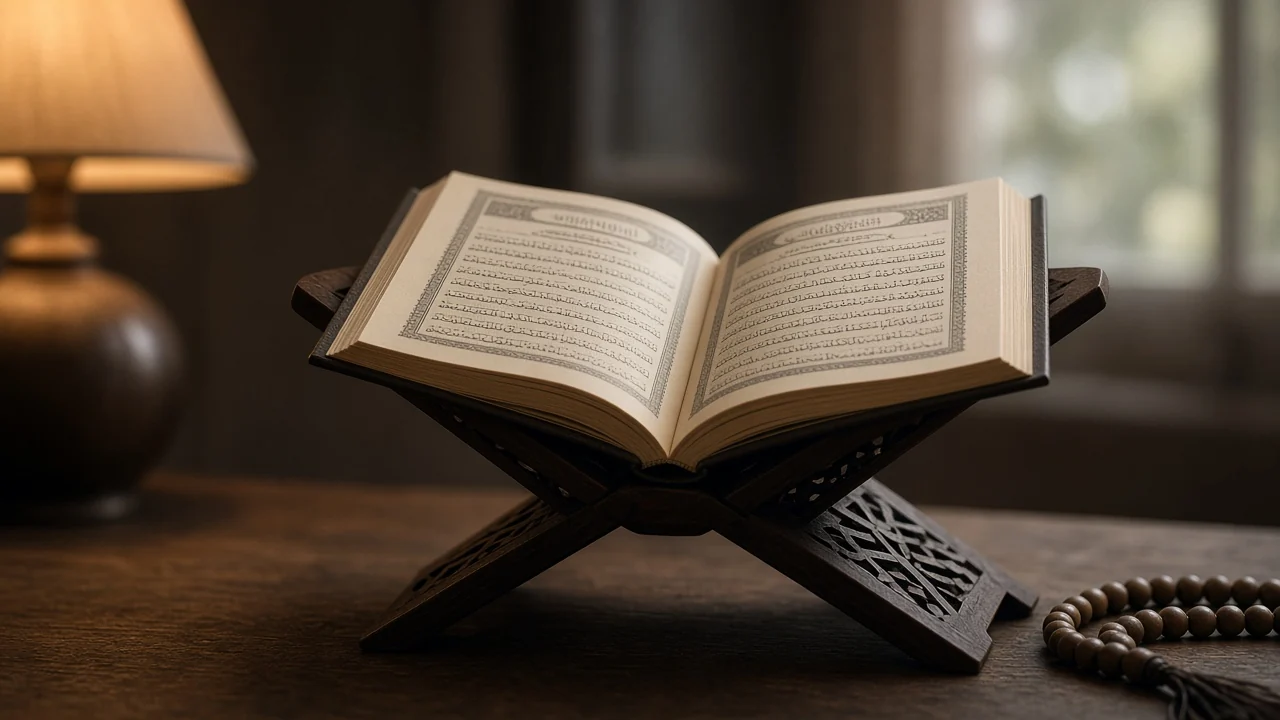
Surah Al-Mulk (chapter 67) and Surah Al-Kawthar (chapter 108) sit at very different lengths, but they can be read side by side as a pair about what is given and who holds it. Al-Mulk opens with dominion in the hand of Allah. Al-Kawthar, one of the shortest chapters in the Qur'an, begins with a grant of al-kawthar to the Prophet. This article sets the Sahih International wording of both chapters next to each other so you can see those themes in the text itself.
Translations below are Sahih International, via Quran.com. No claim is made here about legal rulings, virtues, or reports outside the verses quoted. For a continuous English reading of chapter 67, use Surah Mulk in English or the translation page.
Where the two chapters sit
Al-Mulk is thirty verses and opens Juz 29. Its name is often rendered "Dominion" or "Sovereignty," matching the first verse. You can read Surah Mulk online in Arabic with a translation beside it, and you can check the same wording on Quran.com's Surah Mulk page.
Al-Kawthar is three verses and belongs to Juz 30. Its title is commonly rendered "The Abundance." The Sahih International translation keeps the Arabic word al-kawthar in the first verse rather than replacing it with a single English noun. You can read the chapter on Quran.com's Al-Kawthar page and in the Sahih International translation view.
Length is the first practical difference. One chapter can be read slowly as a full sitting. The other can be read in a single breath, then repeated so the three lines stay in view. A pairing is not a claim that the two chapters are a formal liturgical set. It is only a way to notice shared language about giving, provision, and the One who gives.
Other Juz 30 pairings on this site, such as Surah Mulk and Surah Asr or Surah Mulk and Surah Quraish, follow the same idea: place the wording of two chapters next to each other and stay with what the translation says.
What Al-Kawthar says (three verses)
Sahih International, Surah Al-Kawthar 108:1–3, as on Quran.com:
Indeed, We have granted you, [O Muhammad], al-Kawthar.
So pray to your Lord and offer sacrifice [to Him alone].
Indeed, your enemy is the one cut off.
The first verse is a statement of grant. The second verse is a command that follows the grant: pray to the Lord and offer sacrifice to Him alone. The third verse names an enemy and says that this enemy is the one who is cut off.
The chapter does not, in this translation, define al-kawthar with a footnote in the main line; the Arabic word remains in the English sentence. Readers who want word-by-word notes can use Quran.com's tools. This page leaves the term as the translation leaves it, rather than building an extra definition around it.
What the three lines already show, without added commentary from other sources, is a movement from gift, to worship directed to the Lord alone, to a reversal: the one who opposes is described as cut off, while the addressee has been granted al-kawthar.
What Al-Mulk says about dominion and provision
Al-Mulk begins with dominion as something in Allah's hand. Sahih International, 67:1:
Blessed is He in whose hand is dominion, and He is over all things competent.
The chapter then speaks of the creation of death and life, of the sky, and of the earth as a place where people walk and eat. Verse 15, again in Sahih International, ties the earth to provision:
It is He who made the earth tame for you - so walk among its slopes and eat of His provision - and to Him is the resurrection.
Other verses in the chapter return to power, warning, and the limits of human sight. You can read them in order on the translation page or verse by verse with word-by-word help. For this pairing, two threads are enough: dominion is in Allah's hand (67:1), and provision on the earth is described as His provision (67:15).
The chapter's length lets those threads unfold. Al-Kawthar states a grant in one line. Al-Mulk places giving inside a wider picture of the sky, the earth, and the return to Allah.
Reading them side by side
A simple way to read the pair is to take Al-Kawthar once, then read 67:1 and 67:15, then return to Al-Kawthar.
- Giving. 108:1 is a grant to the addressee. 67:15 describes provision for people who walk on the earth. Both lines, in Sahih International, make Allah the source of what is given.
- Direction of worship. 108:2 tells the addressee to pray to his Lord and to offer sacrifice to Him alone. Al-Mulk's opening does not use that same sentence, but 67:1 locates dominion in His hand, which is the same Lord the shorter chapter names.
- Contrast with being cut off. 108:3 says the enemy is the one cut off. Al-Mulk, in its longer course, speaks of those who denied a warner and of the punishment they describe after the fact (see 67:8–10 in the full translation). This page does not treat those later verses as a legal comment on any person. It only notes that both chapters set a contrast between what Allah gives and what is lost by denial or enmity, in the wording they actually use.
- Scale. Al-Kawthar is brief and direct. Al-Mulk is spacious. Reading the short chapter first can make the opening of Al-Mulk feel even more like a wide frame around a gift.
You can also reverse the order: read 67:1, then 108:1–3, then 67:15. The grant in 108:1 then sits between dominion and provision.
If you like a printed or offline copy for the longer chapter, the site's PDF downloads page collects file options. For Al-Kawthar, the official wording on Quran.com is short enough to keep in a single screen.
A note on names and transliteration
You will see Kawthar, Al-Kawthar, and Kauthar in English writing. They point to the same chapter, 108. This article uses Kawthar in the title and Al-Kawthar in the text when naming the surah, matching common Quran.com usage.
Al-Mulk is also called by the opening word related to dominion, and some readers know chapter 67 as Tabarak from its first word in Arabic. The Surah Tabarak page explains that naming. The pairing here is still with chapter 67 as a whole, not with a different text.
When you quote, keep the Sahih International lines as they appear on Quran.com, including the bracketed clarifications such as "[O Muhammad]" and "[to Him alone]." Those brackets are part of the translation you are using.
A short reading sequence you can repeat
- Read 108:1–3 slowly in English, then in Arabic if you are able, from Quran.com/108.
- Read 67:1 and 67:15 from Quran.com/67 or from the site translation.
- If you have time, read Al-Mulk from the beginning as far as verse 15, so the two quoted lines stay in context.
- Return to Al-Kawthar once more.
That sequence is only a reading aid. It is not a prescribed rite and is not offered as a ruling about when or how the chapters should be recited.
Sources: Quranic text verified against Uthmani script (Hafs an Asim). Hadith cross-referenced with Sunnah.com and Quran.com. See our editorial policy.