
Surah Mulk Color Coded Tajweed: What Each Colour Means
It is the Arabic text of Surah Al-Mulk printed with tajweed colours. The words are identical to a plain copy; the colours show where rules such as madd (elongation), ghunnah (nasal sound), qalqalah (echo) and silent letters apply.
Last reviewed:
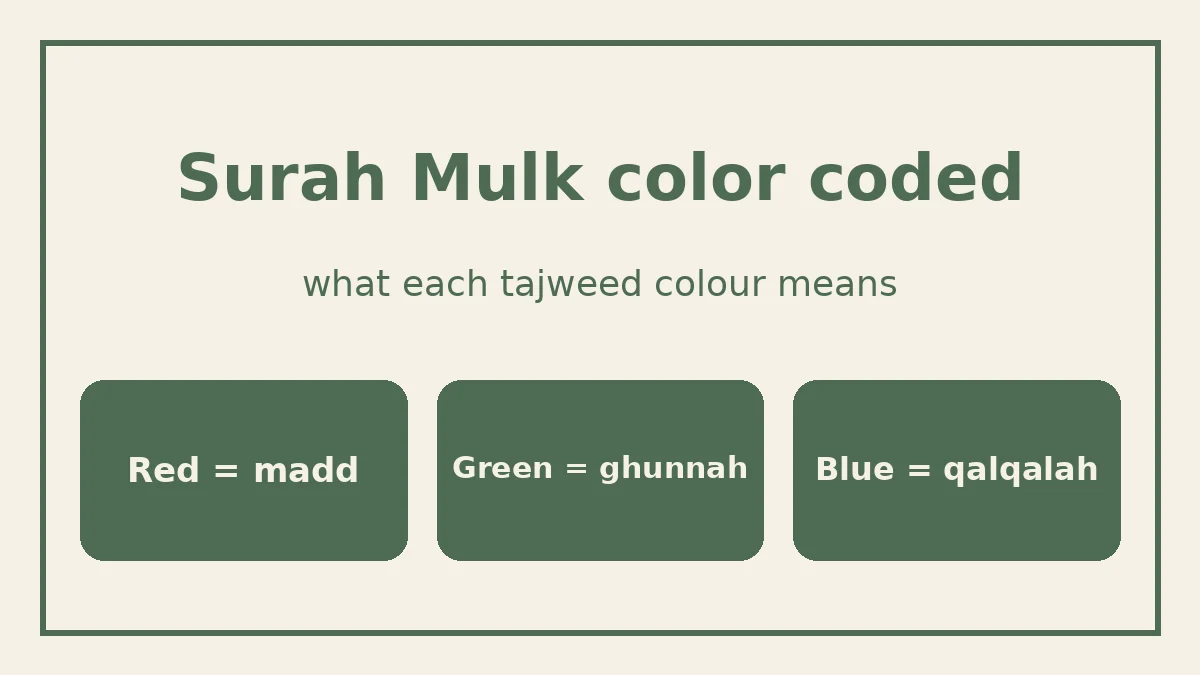
Surah Mulk color coded means the Arabic text of Surah Al-Mulk printed with tajweed colours, so you can see where to lengthen a vowel, where to nasalise, where a letter echoes and which letters stay silent. This guide explains what each colour usually means, shows real examples from Surah Al-Mulk for every colour, and gives a simple plan for practising with a colour-coded page. If you only need the file, the Surah Mulk PDF page has the colour-coded tajweed PDF to download.
What "color coded" means
A colour-coded mushaf (often called a tajweed Quran) prints certain letters in colour to show which tajweed rule applies there. The Arabic text, the words and the verse numbers are exactly the same as in a plain copy. Only the colouring is added, as a reading aid.
One widely used system is the one in the Dar Al-Maarifah tajweed Quran. Its publisher describes the scheme like this:
- Red: letters that need extended vocalisation (madd, elongation)
- Green: letters that are nasalised (ghunnah)
- Dark blue: the emphatic (heavy) letter ra
- Blue: qalqalah, the "echoing" letters
- Grey: letters that are written but not pronounced
Other publishers and apps use their own colours, so always check the key printed at the front or back of your copy. Quran.com, for example, added a tajweed colour view in September 2024 with its own legend.
The colours explained, with Surah Al-Mulk examples
The examples below come from the tajweed-tagged Uthmani text published by Quran.com. Colour names follow the Dar Al-Maarifah scheme described above.
| Colour | Rule | What you do | Example in Surah Al-Mulk |
|---|---|---|---|
| Red | Madd (elongation) | Hold the vowel for the required length | تَبَـٰرَكَ (67:1) |
| Red (darkest) | Necessary madd | Hold for six counts | صَـٰٓفَّـٰتٍ (67:19) |
| Green | Ghunnah, ikhfa, idgham with ghunnah, iqlab | Nasalise through the nose for about two counts | ثُمَّ (67:4); شَىْءٍ قَدِيرٌ (67:1) |
| Blue | Qalqalah | Let the letter bounce slightly when it has a sukun | لِيَبْلُوَكُمْ (67:2) |
| Dark blue | Heavy ra | Pronounce ra with a full, heavy sound | ٱلرَّحْمَـٰنِ (67:3) |
| Grey | Written but not pronounced | Skip it when reading continuously | the first letter of ٱلَّذِى (67:1); the lam in ٱلرَّحْمَـٰنِ (67:3) |
Red: madd
Madd means stretching a long vowel. In a colour-coded copy, deeper reds usually mean longer holds. Surah Al-Mulk opens with one in its very first word, تَبَـٰرَكَ (Tabaaraka). The surah also contains one necessary madd, in صَـٰٓفَّـٰتٍ ("with wings outspread") in verse 19, which is held for six counts.
Green: ghunnah and nasal sounds
Green marks a nasal sound held for about two counts. You meet it on a doubled meem or noon, such as ثُمَّ in verse 4, and in the rules for noon saakin and tanween (ikhfa, idgham with ghunnah and iqlab). In verse 1, the tanween of شَىْءٍ before ق is read with ikhfa, a light, hidden nasal sound.
Blue: qalqalah
The five qalqalah letters are ق ط ب ج د. When one of them has a sukun, it gets a small echo. The first qalqalah in Surah Al-Mulk comes in verse 2, in لِيَبْلُوَكُمْ (liyabluwakum, "that He may test you").
Dark blue: heavy ra
Ra is sometimes heavy and sometimes light. With a fatha, as in ٱلرَّحْمَـٰنِ in verse 3, it is heavy. Dark blue reminds you to give it a full sound.
Grey: silent letters
Grey letters are written but not pronounced in continuous reading. In Surah Al-Mulk, letters of this kind include the connecting hamza (hamzat al-wasl) at the start of ٱلَّذِى and ٱلْمُلْكُ in verse 1 when you join them to the word before, and the lam of "al-" before a sun letter, as in ٱلرَّحْمَـٰنِ.
How many tajweed rules are in Surah Al-Mulk?
Counting the tags in Quran.com's tajweed text for all 30 verses gives a feel for what you will practise most:
| Rule (Quran.com tag) | Tags in Surah Al-Mulk |
|---|---|
| Hamzat al-wasl | 55 |
| Normal madd | 32 |
| Permissible madd | 30 |
| Ikhfa | 28 |
| Idgham with ghunnah | 19 |
| Ghunnah | 17 |
| Lam shamsiyyah | 16 |
| Obligatory madd | 16 |
| Silent letters | 14 |
| Qalqalah | 14 |
| Idgham without ghunnah | 4 |
| Idgham shafawi | 4 |
| Iqlab | 3 |
| Ikhfa shafawi | 3 |
| Necessary madd | 1 |
The takeaway: madd and nasal sounds (green) appear in almost every verse, so those are the rules to master first. The rule-by-rule explanations are on our Surah Mulk tajweed page.
How to practise with a colour-coded page
- Learn the key first. Spend five minutes on the colour legend of your copy before reading.
- Listen while you look. Play one verse from a reciter on the Surah Mulk audio page and follow the colours with your finger.
- One colour per session. For a week, focus only on green, then red, then blue. Trying to apply everything at once is overwhelming.
- Read slowly. The Quran asks us to "recite the Qur'an with measured recitation" (73:4, Sahih International). Speed comes later.
- Check with a teacher. Colours show where a rule applies, not exactly how it sounds. A qualified teacher can correct what a page cannot.
If you are memorising, combine this with our guide on how to memorize Surah Mulk and the listen and repeat tool.
Common mistakes with colour-coded text
- Treating every red the same. Many copies use several shades of red for different lengths of madd. Read the key and learn which shade means which length.
- Over-nasalising. Green means a nasal sound of about two counts, not a long hum. Listen to a reciter to hear the right length.
- Ignoring grey letters. Grey letters are skipped when you join words. Pronouncing the connecting hamza in the middle of a phrase is one of the most common beginner errors.
- Forgetting the rules that have no colour. Most colour schemes do not mark every rule, such as the light ra or every case of stopping. Colours help, but they are not the whole of tajweed.
- Reading too fast. If you are racing, you are not looking at the colours.
Teaching children with a colour-coded page
Colours make tajweed concrete for children, who often remember "green means hum" faster than a rule name. Introduce one colour at a time, starting with green or red because they appear in nearly every verse. Let the child find all the green letters in one verse before reading it aloud. Short, frequent sessions work better than one long lesson. Our Surah Mulk for kids guide has more ideas for young learners.
Colour-coded vs plain text: which should you use?
| You are... | Best choice |
|---|---|
| Learning tajweed | Colour-coded copy plus a teacher |
| Reading daily and already confident | Plain mushaf in the script you know |
| Memorising | The same layout every time, coloured or not |
| Teaching children | Colour-coded, introduced one colour at a time |
| Studying the meaning | Plain text alongside a translation |
Colour coding is a learning aid, not a different Quran. Many people use a coloured copy while learning and move to a plain one later. If you grew up with the South Asian style of mushaf, see our guide to Surah Mulk in the IndoPak script, which explains how that layout differs from the Madani one.
Reading Surah Mulk colour coded online
You can view the surah in colour without printing anything. Quran.com's tajweed view colours the Uthmani text in the browser, and our read online page has the full Arabic, transliteration and translation. For word meanings while you practise, use the Surah Mulk word by word guide. Wondering how much time to set aside? How long is Surah Mulk gives reading times at different speeds.
Printing a colour-coded page
- Print in colour; grey and dark blue disappear on black-and-white printers.
- Use at least A4 or US Letter so small marks stay readable.
- Keep the colour key on the same sheet or the facing page.
- Treat printed pages of the Quran with respect and store them carefully.
Download options, including the tajweed PDF, are on the Surah Mulk PDF page.
Checklist: Surah Mulk colour coded
- Find the colour key in your copy (colours differ by publisher)
- Red = madd; green = nasal; blue = qalqalah; dark blue = heavy ra; grey = silent
- Start with verse 1: تَبَـٰرَكَ (red), ٱلَّذِى (grey first letter), شَىْءٍ قَدِيرٌ (green)
- Practise one colour per week
- Listen to a reciter while following the colours
- Confirm with a qualified teacher
- Print in colour if you print at all
Sources
- Dar Al-Maarifah, "About Tajweed Quran" (tajweedquran-store.com): colour scheme
- Quran.com: tajweed-tagged Uthmani text of Surah Al-Mulk and Sahih International translation (73:4)
Sources: Quranic text verified against Uthmani script (Hafs an Asim). Hadith cross-referenced with Sunnah.com and Quran.com. See our editorial policy.